Sula 3 Compact Unmanned Surface Vessel
Sula 3 compact unmanned surface vessel, 2.5 m long. Takes a survey-grade multibeam with its INS, a light towed side-scan and EO/IR, configured to order.
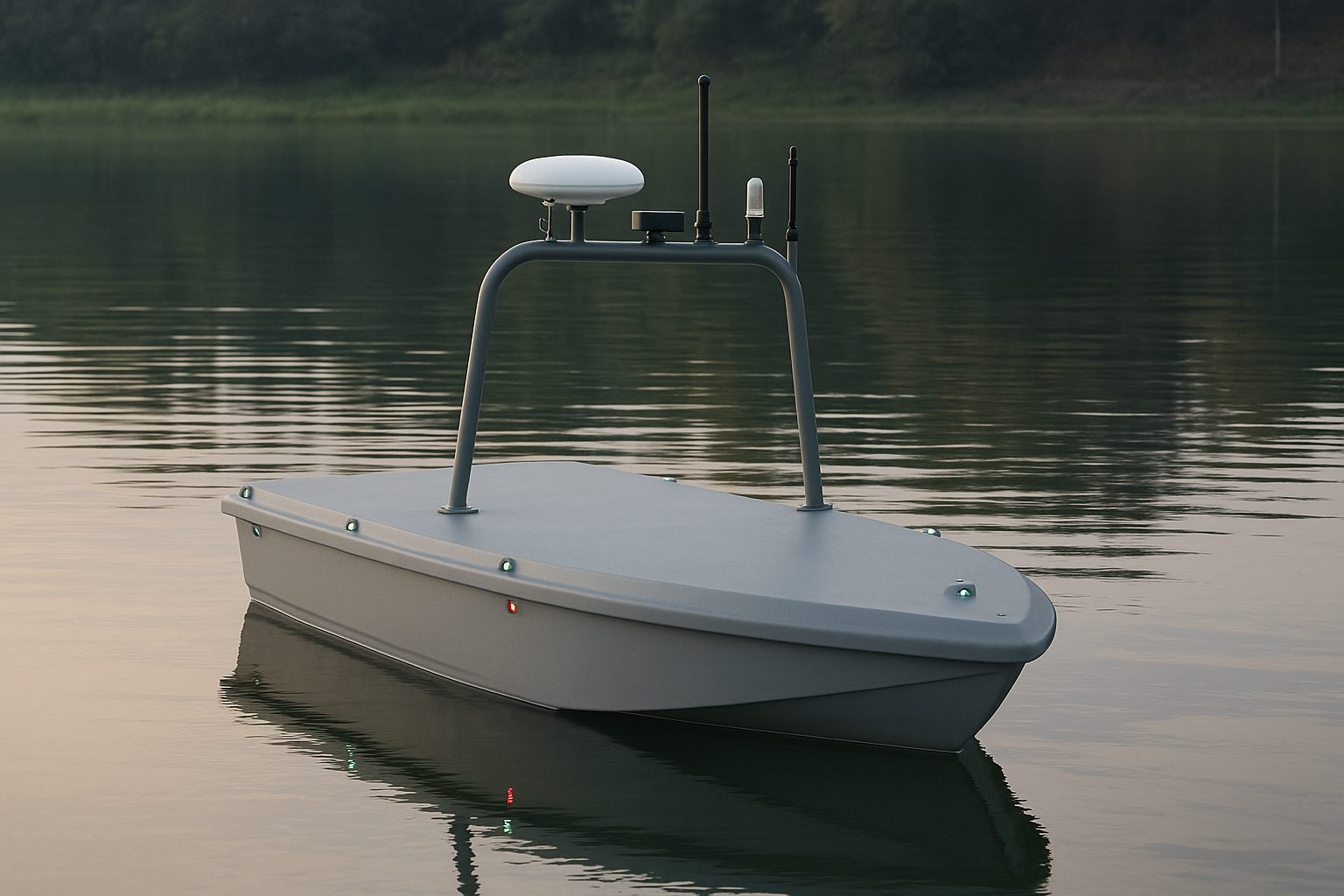
Sula 3 is a battery-electric catamaran unmanned surface vessel, 2.5 m long, with a 100 kg payload. It is the smallest of our platforms for survey-grade multibeam with its own INS and sound-velocity profiler, such as an R2Sonic Sonic 2020-V or a Norbit WBMS, and it also takes a light towed side-scan, a stabilised thermal camera and a radio link for harbour and inshore work. We configure each boat to order, with RTK GNSS position and dual-antenna heading as standard.
Platform specification
| Sula 3 | |
|---|---|
| Length × beam × height | 2.5 × 1.2 × 0.9 m |
| Draught | 35 cm |
| Mass | 85 kg including battery |
| Payload | 100 kg |
| Hull and propulsion | Carbon-composite catamaran; brushless DC electric propulsion; lithium battery |
| Endurance | 5 h at working speed |
| Working speed | 1.5 m/s (2.9 kn) |
| Wind and wave rating | Wind resistance level 4; 1 m wave |
| Water | Harbours, inshore, inland and sheltered water, within the stated sea state |
| Comms | 4G and radio link; data to 4 km, image to 3 km; Starlink for short missions |
| Standard navigation | RTK GNSS position with dual-antenna heading; a motion reference unit or survey INS added for multibeam |
| Optional GNSS-denied navigation | Gap bridging or jamming resilience, configured to order; the export-controlled DVL of jamming resilience is mounted to suit the hull |
Payloads Sula 3 takes
Everything Sula 2 takes also fits. Sula 3 adds the payloads below, all configured to order and integrated per boat:
| Payload | Example models | Mount | Note |
|---|---|---|---|
| Survey-grade multibeam, with motion reference or survey INS and a sound-velocity profiler | WASSP S3; R2Sonic Sonic 2020-V; Norbit iWBMSh, WBMS; Teledyne SeaBat T20-P. Sound velocity: Valeport SWiFT; AML Oceanographic | Hull | The head is light: a Sonic 2020-V head weighs 4.4 kg and draws 20 W on average. Roll and pitch, the mount, and power for the INS and logging computer decide the fit, and are settled per boat. |
| Side-scan sonar, light towfish | Blueprint Subsea StarFish 990F; DeepVision DE340/680 towfish | Towed (the StarFish also on a pole) | A light towfish on a hand reel. Heavier towfish with a depressor start at Sula 5. |
| Hand reel | JW Fishers CMS-1, CMS-2 (slip ring) | Deck | For a light tow. |
| Stabilised thermal camera or EO/IR gimbal | Teledyne FLIR M364, M364C, M364C LR; Trillium HD40; Octopus Epsilon 140 | Mast | Our smallest platform for a stabilised camera or gimbal. |
| Starlink | Starlink Flat High Performance | Mast | Short missions only: its draw is large against a battery hull’s power budget. |
At the edge of this class. A parametric sub-bottom profiler such as the Innomar SES-2000 compact weighs about 37 kg before its survey INS is added. Mass, power and trim decide the fit on a 100 kg payload, so Sula 5 is the comfortable fit.
Where Sula 3 stops. Step up to Sula 5 for a towed magnetometer or gradiometer, a parametric sub-bottom profiler, a towfish on a reel with a depressor, and USBL tracking of a tow. Step down to Sula 2 when the payload is a single-beam sounder, an ADCP, a water-quality sonde or a hull-mounted side-scan, and a 1.6 m boat is enough.
Applications
- Harbour, berth and channel multibeam. Full-bottom coverage of berths, basins, approach channels and dredged areas in sheltered water.
- Inshore survey in harbours and sheltered water, within a 5 h mission.
- Survey along quay walls and under bridges. Where GNSS is blocked, gap bridging is designed to keep the boat on its line (integration available).
- Port security and inspection with a stabilised thermal camera or EO/IR gimbal and AIS.
- Side-scan search with a light towfish on a hand reel.
- River current and water-quality work with a 100 kg payload for the sensor set.
Sula 3 works in harbours, inshore, inland and sheltered water, within the stated sea state, for 5 h per mission at working speed.
Navigation
Standard: RTK GNSS position with dual-antenna heading, from a survey-grade GNSS heading receiver with light inertial (MEMS) aiding. The RTK correction feed comes from a base station on site or from network corrections over mobile data. The longer hull gives the two antennas a longer baseline. For multibeam, a motion reference unit or survey INS is added.
Option: GNSS-denied navigation, two solutions. Both are configured to order on Sula 3, and it is the smallest of our platforms that takes jamming resilience.
- Gap bridging: a tactical-grade MEMS inertial unit, a standard-accuracy Doppler velocity log (DVL), and the dual-antenna RTK GNSS receiver with raw data logged for PPK, with a filtered anti-jam antenna as an option. It is designed for outages of seconds to minutes under bridges, in culverts and beside structures and quays.
- Jamming resilience: a multi-element CRPA with null-steering, a tactical-grade fibre-optic-gyro (FOG) gyrocompass inertial unit, an export-controlled DVL mounted to suit the hull, and an anti-jam multi-band receiver. For regions with deliberate jamming, and subject to export licensing. This inertial unit feeds the autopilot. A multibeam needs a finer heading and motion reference, so the survey GNSS/INS stays as the multibeam’s reference (configured per boat).
GNSS integrity monitoring is included with jamming resilience and is an option with gap bridging; it is configured per boat (integration available), and integration with the autopilot is available. DVL bottom-lock needs the seabed within range, which means shallow water. More on the solutions: GNSS-denied USV navigation.
Integration and support
| Integration | Payload fitted, wired and calibrated on the hull, with sensor offsets and parameters set and the RTK correction feed configured. Autopilot integration is available. |
| Delivery | Commissioning on your water, operator training, and support from our UK and EU teams. |
| Ordering | Configured to order, quoted per boat. |
Questions and answers
Can a compact USV carry a multibeam with its INS?
Yes, configured to order. Sula 3, a 2.5 m catamaran with a 100 kg payload, is our smallest platform for survey-grade multibeam with a separate motion reference or INS and a sound-velocity profiler. The head is light: an R2Sonic Sonic 2020-V head weighs 4.4 kg and draws 20 W on average. Roll and pitch, the mount, and power for the INS and logging computer decide the fit, and each is settled per boat.
Can a compact USV tow a magnetometer for UXO survey?
Towed magnetometers start at Sula 5. A magnetometer tow needs tow force and enough layback to keep the sensor clear of the hull’s magnetic signature. The smallest hull with a record of towing Geometrics G-882 magnetometers on offshore-wind UXO survey is 4.5 m long.
Can a compact USV carry a sub-bottom profiler?
A parametric profiler such as the Innomar SES-2000 compact weighs about 37 kg before its survey INS. Against Sula 3’s 100 kg payload, mass, power and trim decide the fit, and Sula 5 is the comfortable fit.
Does a compact USV take Starlink?
For short missions. A Starlink Flat High Performance terminal draws a large share of a battery hull’s power budget.
What GNSS-denied navigation fits a 2.5 m USV?
Both solutions, configured to order. Gap bridging suits outages of seconds to minutes under bridges and beside structures. Sula 3 is our smallest platform that takes jamming resilience: a multi-element CRPA with null-steering, a tactical-grade fibre-optic-gyro inertial unit and an export-controlled DVL, mounted to suit the hull, subject to export licensing.
Discuss a USV
Tell us about the payload, the water you work on and how long each mission runs.
